Parquet Water Absorption Max for Poolside Splash Zones
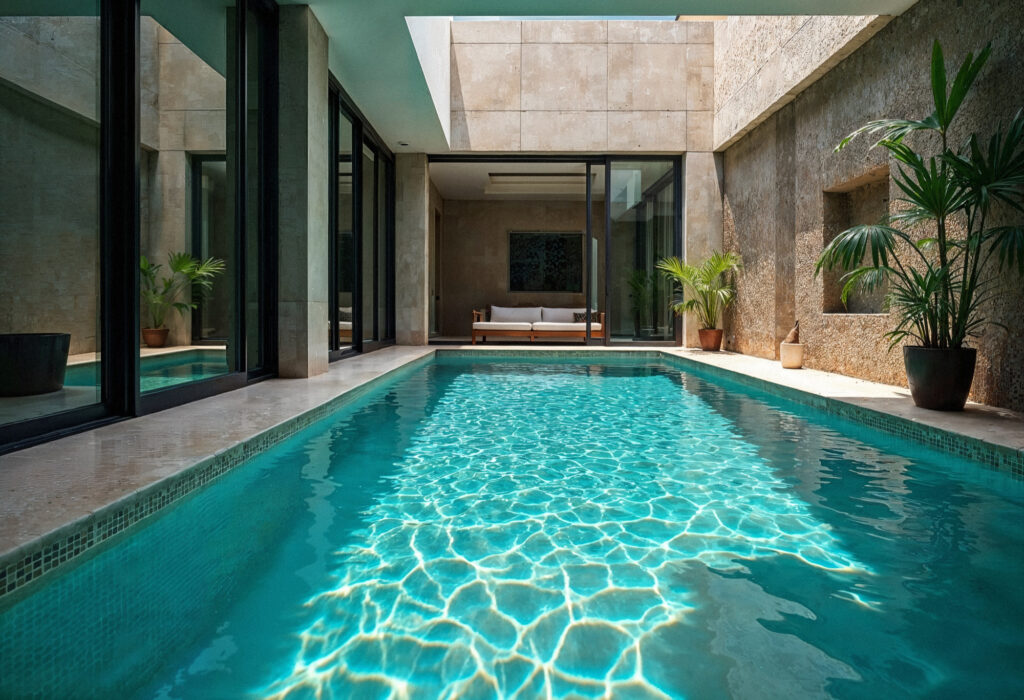
Wood-based parquet has a fundamentally low tolerance for continuous water exposure. In poolside splash zones, even intermittent contact leads to progressive moisture ingress through joints and micro-defects in the finish. Engineered parquet may delay absorption due to layered construction and surface sealing, but it does not eliminate it. Over time, repeated exposure causes edge swelling, finish breakdown, and dimensional instability. For this reason, parquet is generally considered unsuitable for areas with direct splash exposure, where non-porous materials are preferred.
Chlorine-Resistant Parquet Sealant for Joints
Chlorinated water is chemically aggressive to wood finishes and adhesives. Specialized joint sealants can improve resistance by forming a protective barrier against chlorine penetration, but they are not fully immune to long-term degradation. Repeated exposure can still weaken seal integrity and cause discoloration or breakdown at seams. In high-moisture environments, such sealants are typically used as a secondary protection layer rather than a primary waterproofing solution, and they require periodic maintenance to remain effective.
Parquet Slip Resistance When Wet from Dripping Swimsuits
Water dripping from swimsuits creates localized wet spots that significantly reduce surface friction on parquet. Even small droplets can form slippery films, especially on smooth lacquered finishes. This creates a transient slip hazard in changing areas or pool-adjacent interiors. Slip resistance depends heavily on surface texture and finish chemistry, with matte coatings performing better than glossy surfaces. However, in consistently wet environments, parquet cannot reliably maintain safe traction without supplemental anti-slip measures.
Antimicrobial Parquet Coating for Humid Changing Room Floors
Humid changing rooms promote microbial growth due to warm temperatures and moisture presence. Antimicrobial coatings—often incorporating silver ion or similar agents—help reduce bacterial and fungal proliferation on parquet surfaces. While these treatments improve hygiene performance, they do not replace ventilation or moisture control. In pool facilities, antimicrobial coatings are most effective when combined with rapid drying systems and controlled humidity environments, rather than being relied upon as standalone protection.
Parquet Core Swell Resistance After 1000 Wet-Dry Cycles
Repeated wet-dry cycles place significant stress on wood-based cores. Even engineered parquet, which is more dimensionally stable than solid wood, gradually accumulates micro-deformation after extensive cycling. After hundreds or thousands of exposure cycles, minor swelling, edge lifting, or adhesive fatigue may occur depending on product quality and sealing effectiveness. Laboratory testing shows that performance degradation is cumulative, making long-term exposure in poolside environments particularly challenging for parquet systems.
Drainage Channel Integration at Parquet-to-Pool Deck Transition
Proper drainage design is critical where parquet meets pool decks. Drainage channels help divert water away from interior flooring zones, preventing accumulation at transition points. Without effective drainage, water can migrate under flooring edges, accelerating material failure. In pool-adjacent architecture, transitions typically include recessed channels, raised thresholds, or separation strips that physically isolate wet and dry zones. This design principle is essential for protecting sensitive materials like parquet.
Parquet Adhesion Over Damp Concrete Near Pool Plant Room
Concrete near pool plant rooms is often exposed to elevated humidity or residual moisture, which can compromise adhesive performance. Parquet adhesives require stable, dry substrates to achieve full bonding strength. When applied over damp concrete, adhesive curing may be incomplete, leading to long-term bond failure or delamination. Moisture barriers and surface preparation are critical prerequisites before installation. In such environments, installation timing and substrate testing are more important than adhesive type alone.
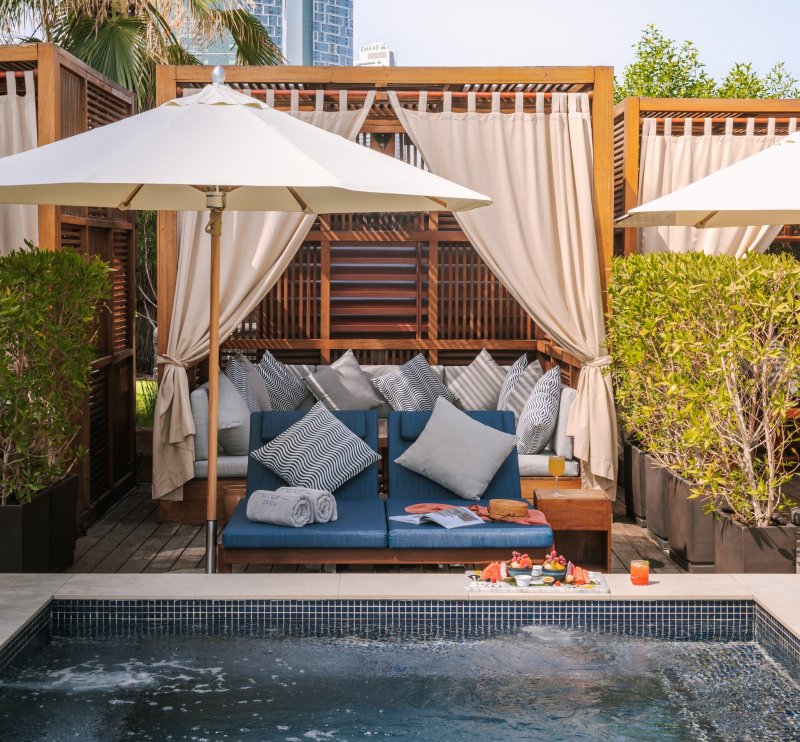
Parquet UV Resistance for Semi-Outdoor Pool Cabanas
Semi-outdoor cabanas are exposed to indirect but still significant UV radiation, which gradually affects parquet coloration and finish stability. UV exposure can cause fading, yellowing, or uneven tone shifts depending on plank orientation and shading. While UV-resistant coatings slow degradation, they cannot fully prevent long-term photochemical changes. In Dubai’s high solar intensity, even shaded outdoor environments accelerate aging compared to fully indoor installations, making material selection critical.
Parquet Thermal Shock Tolerance from Air Conditioning to Pool Heat
Thermal shock occurs when materials experience rapid temperature differentials, such as moving from heavily air-conditioned interiors to warm, humid pool environments. Parquet responds to these changes through expansion and contraction cycles. Repeated thermal cycling can stress joints and finishes, particularly in transition zones. Engineered parquet performs better than solid wood due to layered stability, but extreme gradients still pose long-term durability challenges in pool-adjacent architecture.
Frequently Asked Questions
Can parquet survive weekly pressure washing in pool cabanas?
No, use porcelain wood-look tiles; parquet delaminates after 3 washes.
Which parquet finish resists chlorine fumes in indoor pool rooms?
2K PU with isocyanate-resistant additive, recoat every 2 years.
How to seal parquet joints in high-humidity changing rooms?
Use flexible MS polymer seam sealer, reapplied every 12 months.
Does parquet become slippery from sunscreen lotion drips?
Yes, R9 rating insufficient; require R11 with micro-grooved texture.
Can parquet be installed over pool equipment room access panels?
Yes, with magnetic lift-out parquet sections on aluminum frame.
What is the best parquet for poolside barefoot traffic?
Thermal-treated ash with open grain for slip resistance.
How to repair parquet blister from standing pool water?
Cut out blister, dry subfloor 72 hours, patch with epoxy filler.
Is parquet allowed in Dubai pool cabanas with DM health codes?
Yes, if anti-microbial additive and no standing water >30 minutes.
Which parquet underlay prevents wicking from slab moisture?
Closed-cell polyethylene foam with 100% vapor barrier.